
Traffic Court Records in Louisiana
In Louisiana, the court named on the citation holds the record you need. Traffic cases land in city or municipal, parish, mayor's, or other courts with traffic jurisdiction. Some serious traffic charges move through the system as criminal cases. The parish Clerk of Court is not always the ticket custodian. Court tiers and local docket systems differ. So go by the court printed on the ticket rather than guessing from the parish.
A local court docket can list the citation, plea, appearance, costs, hearing, and final entry in the case. License suspensions and debt flags live elsewhere. They sit with state agencies. No statewide ticket-status search exists in Louisiana. It cannot confirm whether a citation was paid, contested, or set. For a full answer, contact the named court. If a driver-status flag is in play, contact the responsible state agency too.
Louisiana Has No Statewide Ticket Search
Louisiana has statewide tools that touch traffic charges and license compliance. None is a universal citation-status portal. The Supreme Court's charge-code search helps you identify court costs tied to a court and offense. It will not take a ticket number. It also cannot show whether a citation was paid, contested, dismissed, scheduled, or sent to the Office of Motor Vehicles. Local court sites and payment services are separate systems.
The LCRAA criminal-minute search does not close the gap either. Louisiana R.S. 13:5992 expressly leaves traffic violations outside the required criminal-minute access lane. So if a ticket is missing from a criminal portal, that is normal for traffic. That absence says nothing about payment or status. Begin with the court on the ticket. Then try that court's case search, payment route, clerk, or phone. The statute spells out exactly where the statewide criminal-minute requirement stops.
Note: a charge-cost reference can explain an amount. Only the issuing court can confirm case status.
Statewide Citation and License-Hold Systems
Each of Louisiana's statewide traffic-related systems does a different job. The charge-code site is a cost and offense reference, not a ticket query. OMV handles driver-license suspensions and compliance steps tied to eligible failure-to-appear or unpaid-ticket flags. The Office of Debt Recovery may manage other debt flags. Local courts keep the citation docket. Never use one system's result to guess what another holds.
| System | What It Holds | Run By |
|---|---|---|
| Louisiana charge-code search | Court and offense cost references; not a citation number or case status | Louisiana Supreme Court |
| Local ticket search or payment service | Case-specific citation status for the court offering the service | Court named on the ticket |
| OMV suspension and compliance | Eligible driver-license holds and proof-of-compliance steps | Louisiana Office of Motor Vehicles |
| OMV and debt-status route | Personalized driver-status and debt flags; details depend on the source agency | OMV or Office of Debt Recovery, depending on flag |
| LCRAA Criminal Search | Covered criminal minute entries; traffic violations are excluded | Louisiana Clerks of Court Records Access Authority |
The table keeps a cost lookup, a local court case record, and driver-status files distinct. Louisiana does not run one statewide citation database that blends all of these functions.
Louisiana Charge-Code Search Finds Costs
The Louisiana charge-code form answers a narrow question: what does a court list for a charge? It will not tell you whether a ticket has been resolved. Its visible controls include “Choose Court,” “Date of Offense,” and “Search Filter / Enter Search Terms.” An advanced-search area adds “Search By,” “Law Category,” and “Charge Category” options. The dynamic lists change their contents depending on the query.
No ticket or citation number will locate a case through this cost-reference form. The public interface needs no account. But its results are not a payment receipt or a court-status confirmation. Check the official court site for current instructions. Verify any amount with the court named on the ticket. The official Louisiana charge-code search presents court, offense-date, and charge-search controls for cost lookups.
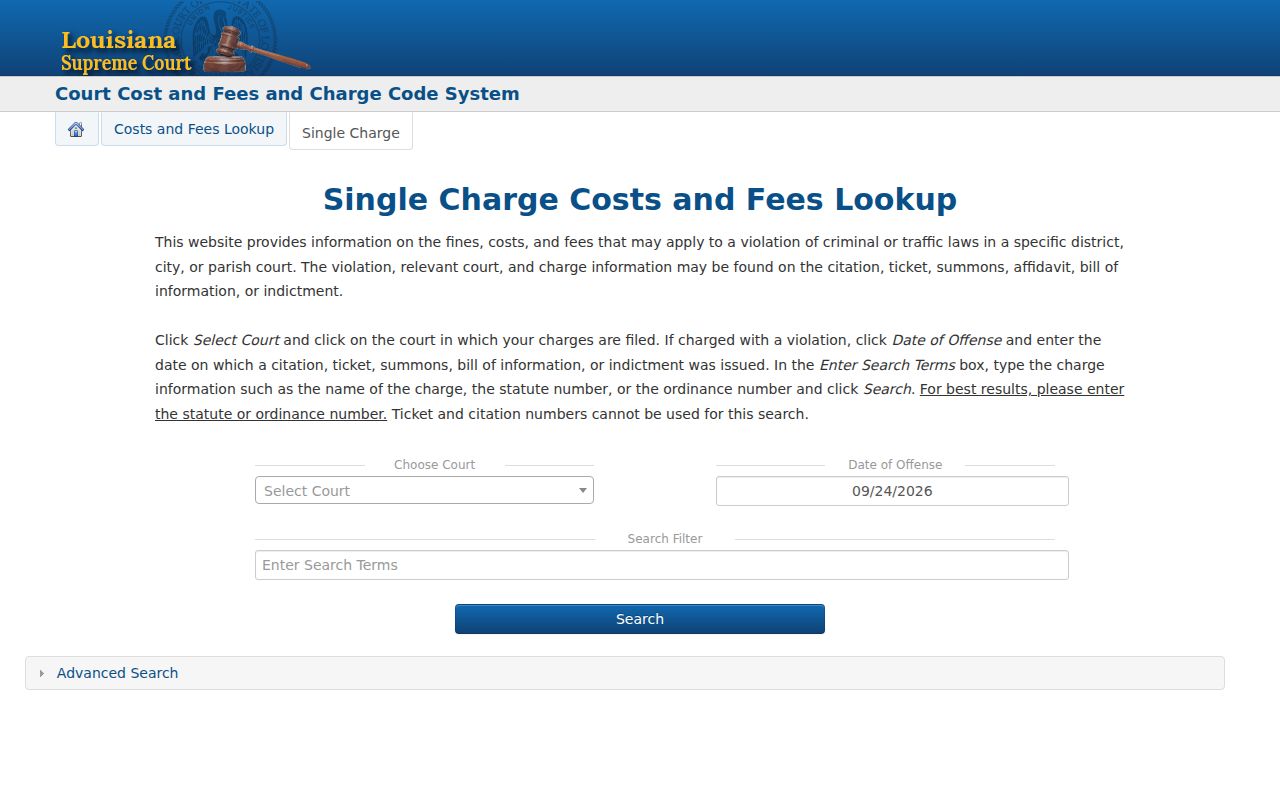
This capture shows the cost-search form and its filter controls; it displays no ticket result and no payment status.
Note: verify local ordinances and current costs with the issuing court, because the statewide reference may not answer every local charge question.
How to Look Up a Louisiana Traffic Ticket
Read the citation first. It names the issuing court, the ticket number, the appearance date, and the instructions. Louisiana has no statewide status search. The court printed on the ticket decides where to look. A parish Clerk of Court may be the wrong office. That happens when the matter belongs to a city or municipal court. The parish directory can help you find the local Clerk of Court. A city court's own official page may be the more direct route.
- Identify the exact court named on the citation and confirm whether it is a municipal, parish, mayor's, or district court.
- Use the court's local case search, payment service, clerk, or phone route. The statewide charge-code site finds costs, not a ticket by citation number.
- For parish district-court matters, use the Louisiana parish directory to find the local clerk. For a city court, follow the court printed on the ticket because this hub has no city directory.
- Check the case entry for the court date, plea, amount due, and disposition. Verify deadlines and payment instructions with the court if the screen is unclear.
- Save the receipt or court confirmation. A local case search and a separate payment portal may be different services.
New Orleans Municipal and Traffic Court offers a local case lookup worth knowing about. Its search form asks for a case number, last name, first name, and date of birth. Nothing on the page marks which fields are required. A partial entry may return nothing. Cases older than 2002 are not in the system. The court says you must contact it directly for those. A separate payment portal exists. It starts by asking for the ticket number.
Keep the scope in mind, though. The New Orleans Municipal and Traffic Court case-search page is a local form for that one court. It is not a statewide Louisiana traffic search.
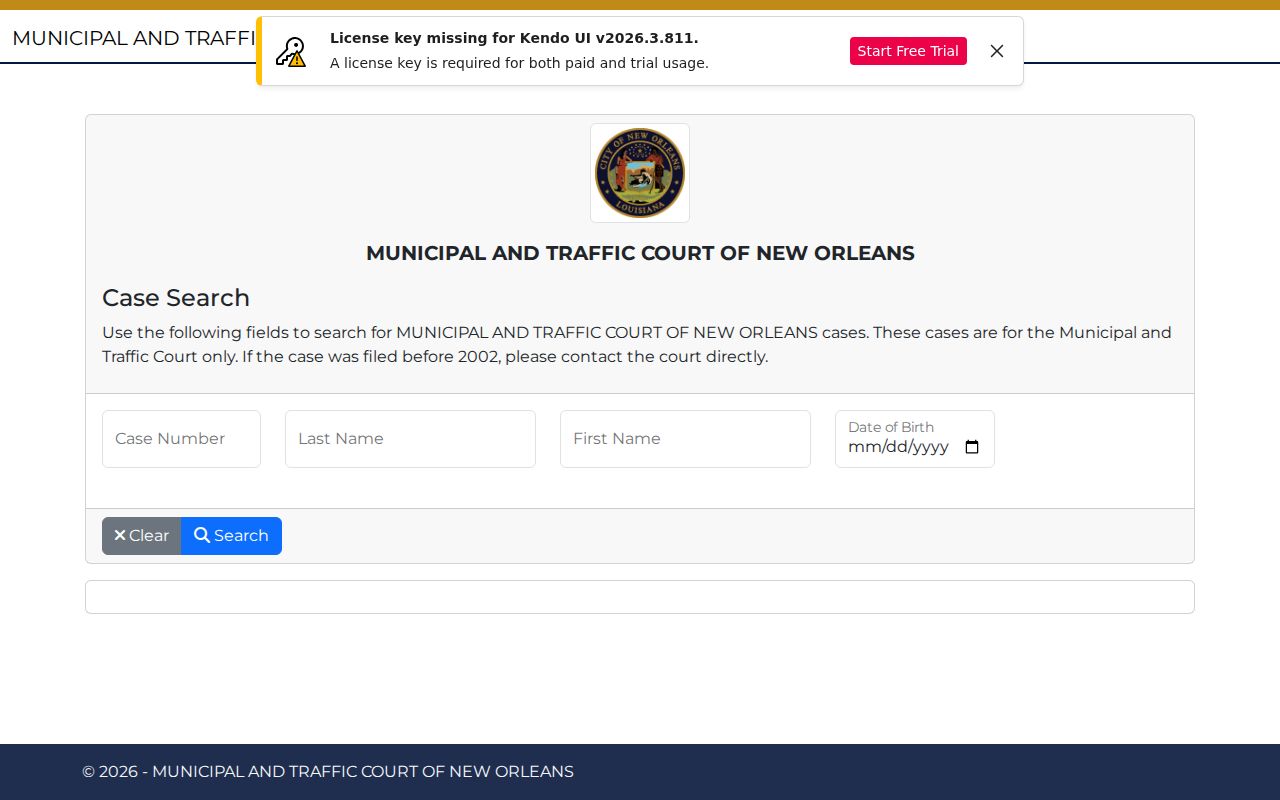
The image shows search labels alone, with no case result behind them. Other Louisiana courts may use different fields or offer no online search at all.
Louisiana OMV FTA Holds Need Court Proof
Two systems track one ticket in Louisiana. The local court docket holds the case itself. The Office of Motor Vehicles tracks what happens to your license. When a failure-to-appear or unpaid-ticket flag appears, OMV expects proof before it lifts anything. That proof varies. It may be a compliance record from the court, a paid receipt, a final disposition, or an affidavit showing a new date. Start with the court named on the citation. Its clerk can tell you exactly what was entered on the docket.
The OMV suspensions page also posts administrative fee categories tied to specific flags. The listed amounts include $100 for a Louisiana court matter, $60 in-lieu, $60 out-of-state court, $87.50 for Shreveport City Court, and $50 for motor-carrier matters. Read those numbers carefully. They are OMV reinstatement fees for the flag category. They are not the unpaid fine, not local court costs, and not one universal charge. Confirm amounts on the current OMV page before sending money.
For the paperwork itself, the official Louisiana OMV compliance page walks through the documentation certain failure-to-appear and unpaid-ticket flags require.
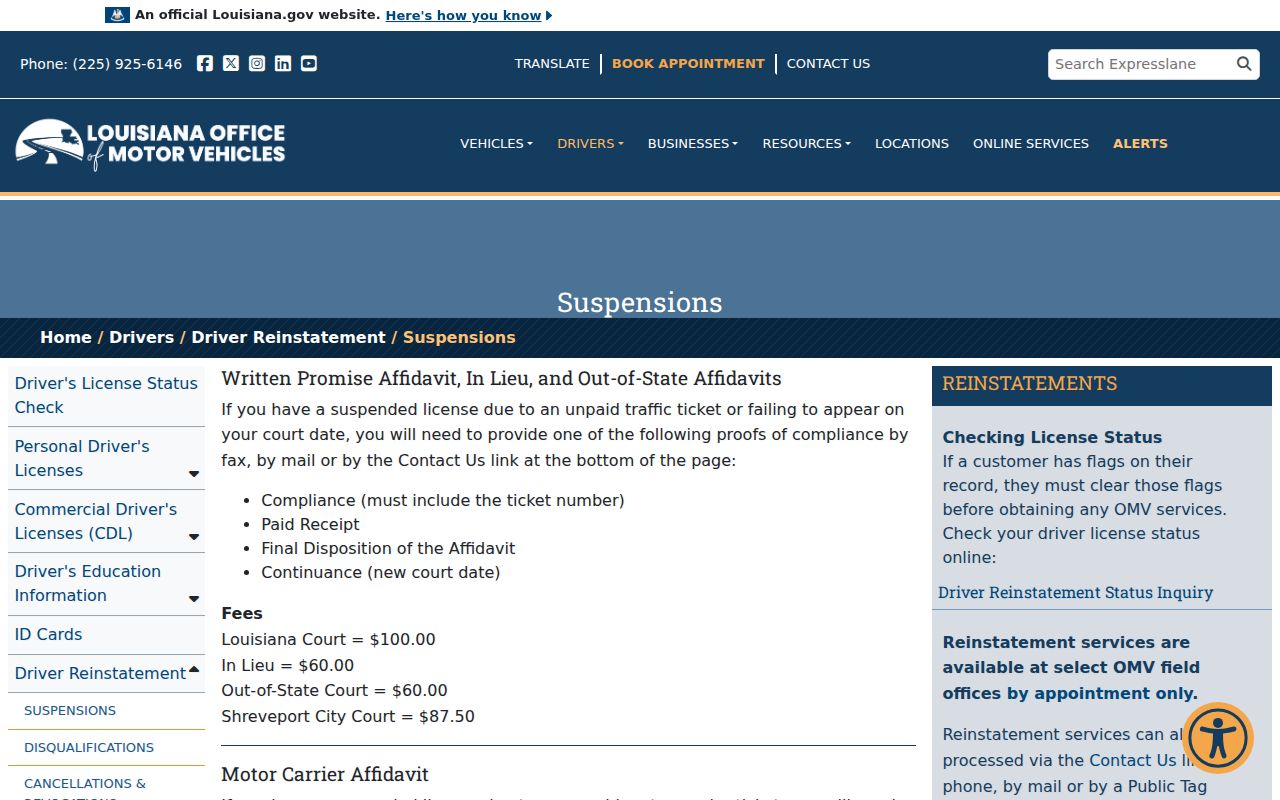
None of that is the ticket docket. OMV handles contact, payment, and status checks on its own current directions, apart from the local court record.
Note: Paying a ticket does not itself prove that OMV has received the needed compliance record or removed an eligible flag.
Paying or Contesting a Ticket in Louisiana
How you answer a Louisiana ticket depends on the court that issued it. It also depends on the charge listed. Paying can resolve the case under that court's rules. But the legal effect varies. A payment may count as a plea. What it means for your court record is set by the process, not the button you click. To fight the ticket, follow the citation or the court's official instructions for a not-guilty plea and a hearing or trial date. The statewide charge-code tool won't take the ticket number. It can't replace any of these steps.
| Paying the Ticket | Contesting the Ticket |
|---|---|
| Use the named court's payment method; the plea or disposition effect depends on charge and court process. | Enter a not-guilty plea by the court's stated route and follow the instructions for a hearing or trial. |
| Follow the citation and local court deadline. No single statewide payment window was verified. | Respond by the appearance date or other deadline stated by the court; ask promptly if it is unclear. |
| Pay through an official court channel that the citation or court site identifies. | Contact the issuing court for the required appearance or written request; do not rely on the cost-search form. |
One timing rule comes from Louisiana R.S. 32:391. It generally sets the summons appearance time at least five days after arrest, with statutory exceptions and a route to an earlier hearing on demand. Read the citation and the current statute. That five-day rule is not a payment deadline.
Missed date or payment: The court may record a failure to appear or refer an eligible matter to OMV, where a license hold or reinstatement step can follow. Consequences depend on the ticket and court. Contact the issuing court to learn what was entered, then use OMV's current compliance route if the driver-status record shows a flag.
After a traffic conviction, reporting is governed by Louisiana R.S. 32:393, which covers what disposition information gets transmitted. Ask the clerk whether the court sent it. Then verify license status with OMV directly. A closed case on a court screen does not prove an agency flag is gone.
Louisiana Traffic-Course Options Have Limits
Some Louisiana drivers can take a traffic course instead of eating a conviction. Louisiana Code of Criminal Procedure article 892.1 lets a court, in specified circumstances, offer a driver-improvement course with possible sentence suspension or dismissal. It is not a right, and it will not erase every ticket. The limits are real. The 90-day deferral provision excludes speeding at least 25 miles per hour over the limit, generally requires a valid license, caps prior course use, and demands a timely request no later than the citation appearance date. Finishing the course still matters, and so do any remaining fines and costs.
Court fees for the course can run up to $10 on top of course charges, fines, and costs. Ask the named court whether your citation qualifies before paying or pleading. The statutory conditions sit in La. C.Cr.P. art. 892.1.
- Driver-improvement course
- A court-discretion option under the statute, with eligibility and completion rules.
- Deferred disposition
- A defined statutory path that is not the same as automatic ticket dismissal.
- Administrative camera citation
- A mailed citation may use a separate administrative process under the applicable statute, rather than a criminal-conviction path.
Camera tickets mailed to Louisiana drivers carry their own protections under Louisiana R.S. 32:48. For qualifying mailed citations, the local authority must offer an administrative hearing. It must give at least 15 days to respond, an independent hearing officer, a written decision, and a path for judicial review within 30 days after an adverse decision. The administrative process itself costs nothing. The details have conditions and exceptions, though. These rules do not make every camera notice invalid. They also do not route such notices into traffic court. Check the current statute and the issuing local authority before responding.
Note: A traffic-course request or camera hearing must go through the court or authority named in the particular notice.
Court Traffic Record vs Driver Record
One citation, two records. In Louisiana, the local court file holds the citation, appearance, plea, disposition, and court costs. The driver-status record sits with the state agencies. Those agencies manage license status, suspension, and debt flags. Neither one tells the whole story. A court page can show a case closed while an OMV flag stands. A driver-status screen, in turn, will not reproduce the court docket or the judgment behind it.
| Court Traffic Record | Driver Record | |
|---|---|---|
| Kept By | The court named on the citation and its clerk or records office | Louisiana OMV for license status; ODR may manage separate debt flags |
| Shows | Citation, plea, court date, filings, disposition, and court costs | Convictions, points, license status, suspensions, compliance flags, or debt status |
| How to Get It | Use the local court lookup or request the record from the clerk | Use the official OMV or ODR status and compliance route |
Different offices hold these records. Get the court file from the issuing court, and confirm license compliance through the agency responsible for it.
Louisiana Ticket Paid, OMV Hold Remains
Paying a Louisiana ticket does not always lift the flag on your license. Before you pay again, check both records. Ask the issuing court first: was the receipt or disposition entered, and can the court give you proof of compliance? That proof matters more than the payment itself.
Then turn to OMV. Follow its instructions for the specific suspension reason listed on your record. A court payment portal may not forward every document OMV needs, and an online case status that shows the ticket as paid will not, by itself, clear an agency hold.
The Louisiana Office of Debt Recovery's OMV guide walks through the driver-status and debt-flag route, and it separates flags managed by OMV from those handled by ODR.
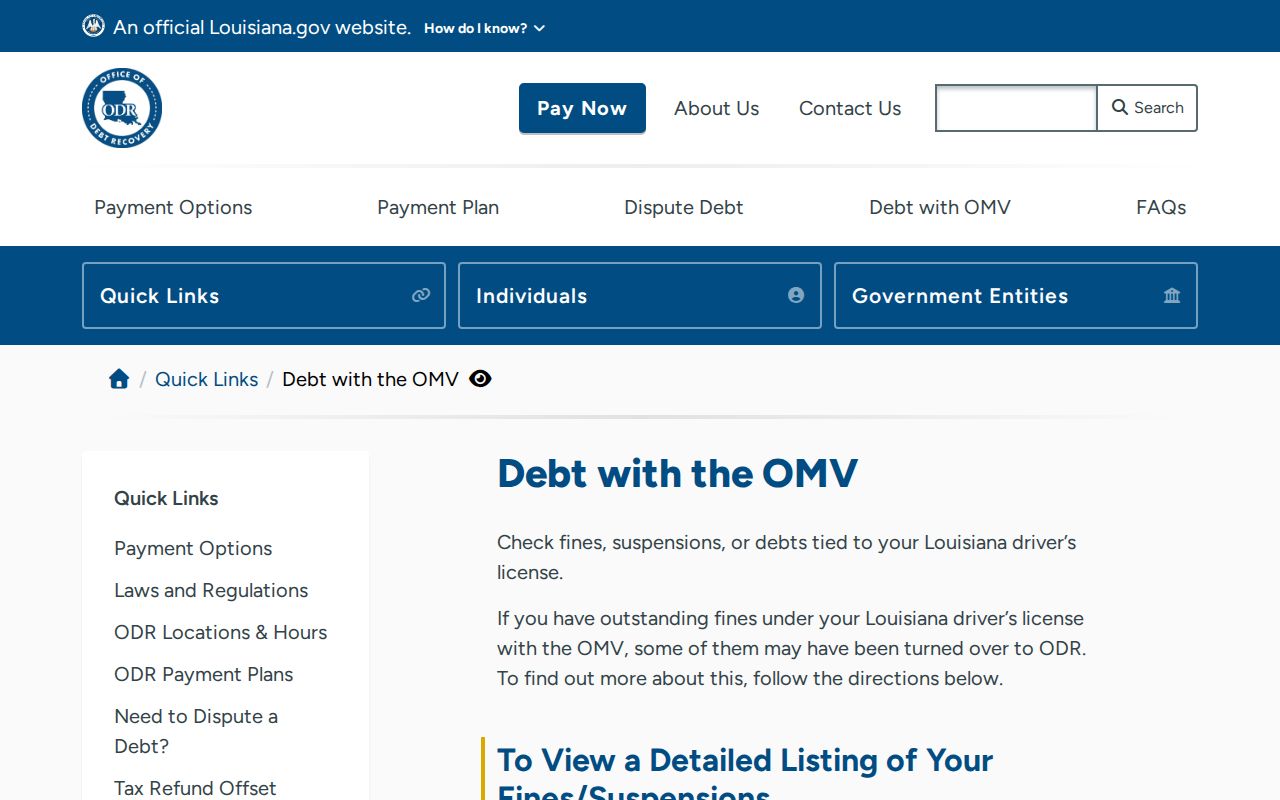
Paying a Louisiana traffic ticket settles the court side of things. It does not always clear the flag on your license. That hold sits with OMV, a state agency, and it follows its own timeline.
Keep your paperwork straight while you wait. The online dispute route cannot lift an OMV hold. OMV controls that flag, not the court. A nonresident failure-to-comply report under Louisiana R.S. 1441 works the same way. It is part of the licensing process, not a public ticket search. So confirm each status with the office that holds it.