
How to Search Louisiana Civil Dockets
Before searching, gather the basics. The court and parish matter most. Next come the case number, the case style or party names, and a rough filing year. Louisiana's eClerks Statewide Portal indexes civil, family, and succession material for parishes that participate. Coverage by category and era varies. A hit there is only a lead. The portal does not list every filing event or promise an image of a petition, motion, or judgment. The official civil docket and file stay with the local Clerk of Court or another court clerk.
Louisiana also lacks one shared trial-court case-number format or a uniform civil search form. The court named in the case paper tells you which system to use. Find the likely index first. Then turn to the local office for the docket sheet, a specific filing, or a certified copy.
- Read the case paper for parish, court, division, case style, party names, and filing year. District civil, family, succession, city, and justice-of-the-peace matters may use different custodians.
- Try the eClerks Statewide Portal for the civil, family, or succession index categories it lists. Sign-in is required to reach the statewide query, and the after-login case fields were not publicly inspectable.
- If no result appears, check the parish Clerk of Court's own search or a local multi-parish service. The Louisiana parish directory routes to the local clerk; Orleans civil matters use a separate Civil District Court clerk.
- For a document, identify its title or docket date and ask whether it is available as an image, plain copy, or certified copy. An index entry is not the filed paper itself.
- Confirm current charges, payment, and delivery rules with the custodian before sending a request.
Louisiana Civil Indexes in eClerks LA
eClerks LA is a gateway organized around particular record classes. It is not one complete Louisiana civil docket for every court. Its public description lists civil, family, and probate or succession index categories among participating parishes. The direct statewide portal asks for an account. Without signing in, the system offers no case-type choices, parish fields, date filters, result limits, export controls, or case-level event fields. Do not guess those details from a different eClerks module or user guide.
Know what you are paying for. A free index search and a paid image or printed document are separate products. Coverage plus historic depth shift by parish and category. Some documents still need a local purchase or subscription. When the statewide index shows nothing, move on. Try the local Clerk of Court search or call the office holding the file. Louisiana's official Statewide Portal information describes the categories, and the portal entry leads to sign-in.
Note: Land-record search fields are not the Louisiana statewide civil-case form. Never reuse them as if they were.
What a Civil Docket Shows
Think of a Louisiana civil docket as a timeline. It logs each case event and filing in order. A local screen may include the petition, service or return, answer, exception or motion, hearing setting, continuance, settlement, trial, judgment, appeal, or closure. The label itself is only a summary. The pleading or signed order sits behind it as a separate record. The clerk's system may not put its image online.
Case numbers and short event labels also differ across Louisiana courts. Match an index result with the case style and filing date. Then ask the clerk to confirm the specific entry. A notice of appeal is not the appellate docket itself, and a status word is not the full terms of a judgment.
| Case Number | Court-assigned identifier. Louisiana has no verified statewide civil-number format; read the full number from the local record. |
|---|---|
| Case Style | Short title for the parties or matter. Protected cases may use limited public labels. |
| Filing or Return | May note a petition, answer, service return, motion, or order. The original document remains separate. |
| Setting | A status conference, motion hearing, pretrial, or trial date; local calendar data can change. |
| Judgment or Closure | May summarize dismissal, default, judgment, settlement, appeal, or closure. Read the signed order for its terms. |
A docket line can point you to a document, but it cannot replace the document. Ask the clerk keeping the file for a certified judgment.
Louisiana Civil Court Tiers
Most major civil suits land in district court. Yet a civil docket can also belong to a court of limited jurisdiction. Louisiana city courts hold concurrent civil authority within statutory limits that vary by jurisdiction, and justice-of-the-peace courts exercise only the limited powers state law gives them. The court's name plus the kind of relief sought points to the right record holder.
| Court or Division | Common Civil Matters | Record Route |
|---|---|---|
| District court | Major civil suits and many family matters | Parish Clerk of Court civil division, except where a separate clerk serves the court |
| City court | Limited civil cases within statutory jurisdiction | Use the city court named in the case paper; jurisdiction limits differ |
| Justice of the peace | Matters within limited statutory authority | Contact the named justice or court office |
| Succession or probate division | Estate administration and related filings | Ask the parish clerk for the succession or probate record path |
La. C.C.P. art. 4843 fixes each city court's civil jurisdiction limit. Those limits differ from court to court. Never assume a dollar threshold or filing location based on a nearby city. The local Louisiana clerk or court can confirm jurisdiction and which office holds the docket.
Note: Louisiana thresholds vary by jurisdiction. Confirm the city-court limit and filing route with the named court.
Types of Civil Cases on the Docket
Civil docket searches in Louisiana reach well past disputes between businesses or individuals. One case may arrive as a contract or tort claim, another as a property dispute, family matter, succession, or a different civil proceeding entirely. Subject matter and local assignment decide which court and clerk handle the work. Even when a basic case index is visible, some classes carry protected filings or limited remote access.
| Case Class | Possible Docket Activity | Access Note |
|---|---|---|
| District civil suit | Petition, service, answer, motions, settings, judgment | Underlying filings may require a separate image or copy request |
| Family or domestic | Petitions, hearings, orders, continuances | Some documents or identifiers may have restricted remote access |
| Succession or probate | Estate filings, notices, orders, inventory steps | eClerks may index selected materials; local range and images vary |
| City or justice-of-the-peace civil | Claims within the court's limited jurisdiction | Search the named local court, not an assumed parish module |
Labels shift from system to system. A Louisiana civil index category promises no uniform view of every event in every family, succession, or district case.
Separate Louisiana Civil and Criminal Clerks
In most parishes, one Clerk of Court office handles both district civil and criminal filings. The arrangement is not uniform. Orleans Parish splits the work. It runs separate Civil District Court and Criminal District Court clerk operations. Send a civil filing or succession request to the civil clerk; take a felony docket or minute request to the criminal clerk. That local split matters. It is why the exact court name belongs at the top of any request. The official Orleans Civil District Court Clerk site lays out the civil office and its case services.
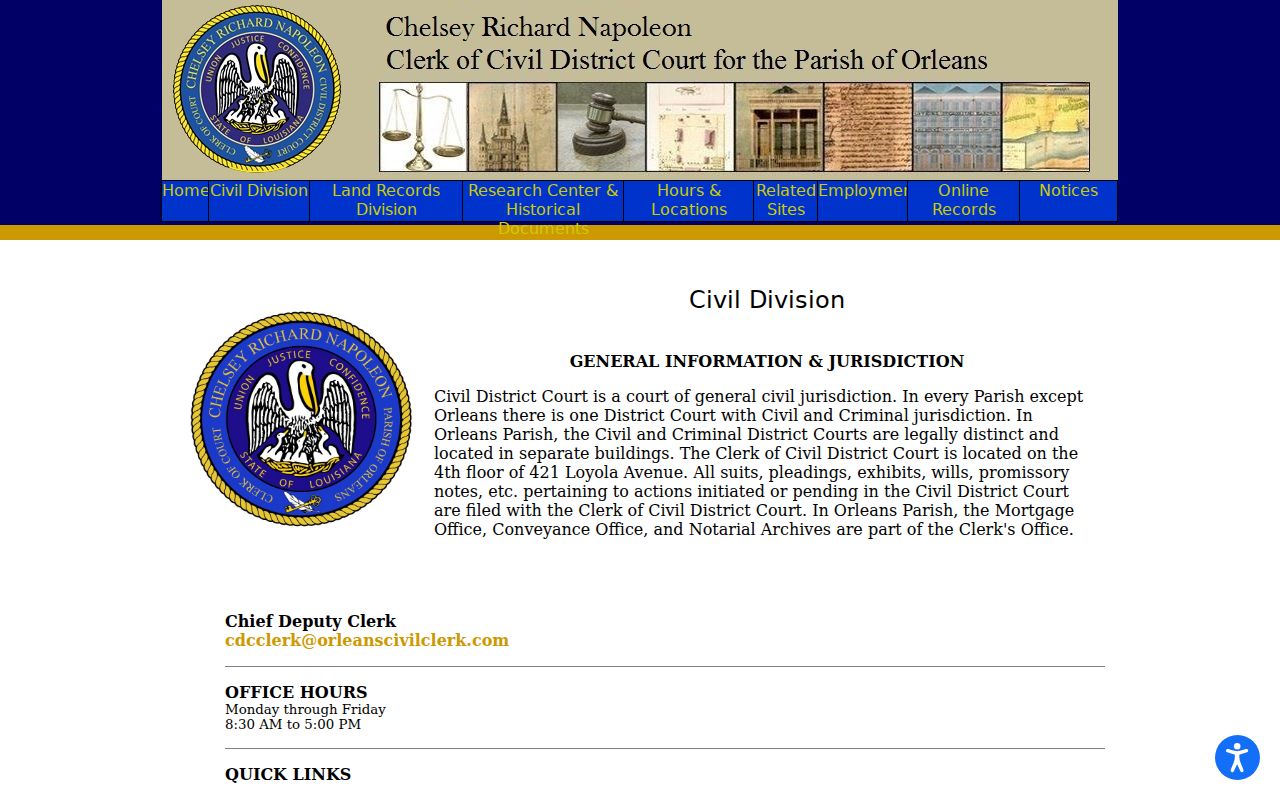
One parish shows how local this can get. Orleans is the example here, not a template for Louisiana as a whole. Its remote access information describes data entry starting in 1985, current software from 2015, and scanned pleadings from that start, with back-scans reaching to 2010. Those dates apply only to that office.
Note: Within a single parish, the separate civil and criminal clerk offices can each demand their own search account, request form, and copy procedure.
Settings and Hearings on Civil Dockets
A Louisiana civil docket line can carry many labels. Status conference, motion hearing, pretrial, trial date, continuance, or reset all appear in these case histories. What a line often lacks is the outcome. It may name a motion without telling you whether the judge granted it, and the written order that follows the hearing is what carries the controlling terms. The setting may also sit on a court calendar kept apart from the case history itself.
Suppose the online docket and the calendar disagree. Check the case number and division first. Then call the clerk or the court division for the current setting, and treat the notice or order served in the case as the official direction. A blank date proves nothing. Louisiana civil matters get continued all the time without a new date while the court arranges its next step.
Louisiana Civil Docket Lines vs Filings
A docket line is shorthand, not the paper itself. In a Louisiana civil case history, “Petition filed” points to the initiating pleading. “Return” records service status. “Motion” records a request for court action. “Judgment signed” signals a separate written record of its own. The history may show only the event date and a short label. Meanwhile, the underlying image stays withheld, fee-based, or available solely through the local clerk.
- Return of service
- Entry that process was served, not served, or returned. Read the actual return if service details matter.
- Exception
- A procedural challenge or objection filed for a court ruling; the entry may not summarize the grounds.
- Continuance
- A proceeding is postponed. Check whether a new date is stated or whether it remains to be set.
- Default judgment
- A judgment entered through a default procedure. Request the signed judgment to understand the result and terms.
Note: These plain meanings help organize a Louisiana docket search. Local labels and case-specific orders still control; Louisiana publishes no statewide civil docket glossary.
Public Access to Civil Dockets
Louisiana's Public Records Law gives the public a general right of access. That right does not put every court filing on a screen. Louisiana Code of Civil Procedure article 251 keeps court records in the clerk's custody. It allows inspection and copying during office hours, subject to other rules. Family and juvenile materials, sealed records, and personal identifiers may carry added limits. The clerk decides which version gets released and whether remote display is permitted at all.
Treat online metadata, scanned pleadings, certified copies, and transcripts as separate products. An index can be open while an image is restricted or simply unavailable. Louisiana law also permits reasonable copy charges. It sets procedures for public-record requests. Local payment rules and request forms still matter.
Louisiana access rules:
La. R.S. 44:31 states the general public access right and places the burden of justifying an exemption on the custodian.
La. R.S. 44:32 addresses reasonable copy charges and request procedures.
La. C.C.P. art. 251 addresses clerk custody, inspection, copying, and certified copies of court records.
Facing a restricted file? Ask the clerk whether a redacted version exists or whether you can file a motion for access. And remember that a missing docket search result does not, by itself, prove a Louisiana civil record is sealed.
Older Louisiana Civil Filings Need Local Review
An online civil case that looks thin may just reflect the clerk's digitization range. Ask the office how far back its electronic records go before concluding a filing never existed. Coverage varies across Louisiana parishes. Orleans reports civil data entry from 1985. It lists scanned pleadings beginning in 2015 and back-scanned documents to 2010. The St. Tammany 2025 civil and succession request form sends pre-1986 records to Archives. Treat these as local examples, not statewide cutoffs.
A specific request usually moves faster than a demand for the whole file. The St. Tammany form asks for the suit or succession number, party names, document type, and filing date. It also asks whether you want plain or certified copies, plus delivery details. Its listed charges run $1 per page, $5 per certified document, and $10 for certified minutes, plus postage. Those are not Louisiana-wide rates. Request an updated quote from the clerk.
Elsewhere, the Secretary of State clerk directory is a good starting point for office contacts. Ask each clerk whether requests can come in person, by mail, by phone, or electronically. Ask whether a public terminal exists and how payment works. The statewide eClerks index may help you find a case. However, copies and archives stay in local hands.
Note: A civil docket index, a full case file, a certified copy, and a reporter transcript can each sit with a different office. Each may follow a separate request path.