
How to Get Louisiana Court Records
Match your route to the record type. eClerks LA indexes land, marriage, civil or family, and succession or probate categories, while local courts may offer a case search, images, or no online search at all. Remember that the statewide index is not a certified file. The clerk or court serving the filing court holds the official record.
Under La. C.C.P. art. 251, you may inspect and copy records at the clerk's office during office hours, subject to other rules. Ask whether a public terminal is available. Some offices accept mail or electronic requests, and a phone call can sort out the right division or fee, though not every office takes phone orders.
A request under the Louisiana Public Records Law, La. R.S. 44:1 et seq., should follow the form and instructions the custodian accepts.
- Note the parish, court, division, and case number from the notice.
- Use eClerks LA or a local court site only if it covers that record type.
- Follow the Louisiana parish directory, or contact the city, parish, or justice court named on the paper.
- Ask the office about online, in-person, mail, electronic, phone, or terminal access and payment.
- Name the exact docket, minute, paper, transcript, or certified copy needed.
Choose the Louisiana Clerk for the Record You Need
In most Louisiana parishes, the Clerk of Court keeps the district case files. The same office holds the minutes and filings. Specialized, lower, appellate, and federal courts often run their own record offices. Orleans splits its district clerk into separate civil and criminal offices. A city traffic citation usually belongs to the court named on the ticket.
"Court records" can mean many things. A docket is one. So are a minute entry, a motion, a judgment, a transcript, or a certified copy. A land index is not a court docket. Use the routing table to find the likely custodian, then confirm locally.
| Record Needed | Likely Custodian | Routing Note |
|---|---|---|
| District civil or felony file | Parish Clerk of Court or division | Orleans separates civil and criminal clerks. |
| Family or juvenile file | Assigned court or district clerk | Confidentiality can limit access. |
| Local citation | Court printed on ticket | May not be held by parish Clerk of Court. |
| Transcript | Official court reporter | Clerk minutes are only a summary. |
| Appeal or federal case | Appellate or federal clerk | Separate file and search path. |
The Secretary of State's Clerk of Court directory lists parish contacts, though it may miss some limited-court clerks. Confirm the court named on the record. Note: Verify the Louisiana court and division first, because record custody can shift between clerk offices.
Types of Court Records in Louisiana
Louisiana produces several distinct record products. A docket indexes events. A minute entry summarizes a court action. The filed document is the petition, motion, order, judgment, or exhibit itself. A transcript is a verbatim record made by the reporter, and certification is the clerk's attestation that a copy is true.
eClerks LA may locate selected indexes, but local access varies. An online hit may lack its image or point to a paid service. The local clerk holds the official docket and issues certified copies.
Before paying, tell the clerk whether you need the full file, a dated minute, a single pleading, a signed order, proof of judgment, or a hearing transcript. The clerk can say if another office keeps the item and whether the request needs a form.
Louisiana Court Record Fees Are Local, Not Statewide
Louisiana sets no statewide copy-fee chart for court records. Each parish clerk publishes its own prices, forms, search charges, and payment steps. So a free index is one product. A paid image is another. A plain paper copy, a clerk-certified copy, and a court-reporter transcript are all separate too. Never assume the amount quoted at one clerk's office will hold for a records request at another parish.
The Tangipahoa Clerk's fee schedule shows one local example. Copy, certification, and filing charges each appear on its own line. It is that clerk's published rate card for its own docket and court records, not a statewide price sheet.
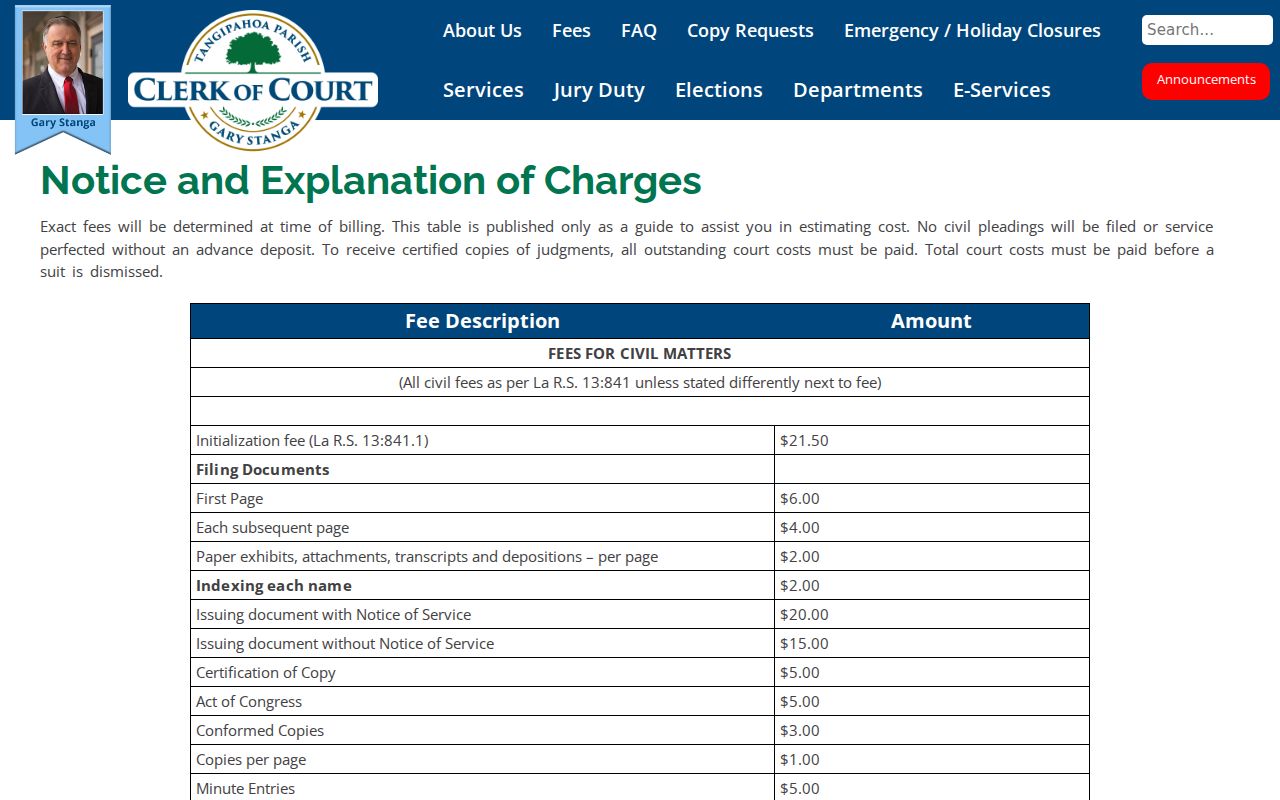
Use the schedule only for that office and confirm its current charges before sending money.
Other clerk examples show why the distinction matters. Civil copies may be priced per page. Minute extracts may be priced by docket. Name searches may be priced by index or name variation. Certification may add its own amount. Postage, payment type, and archive routing can change the final total.
Note: Fee examples help frame a question. Only the current local clerk schedule sets the bill.
What a Court Record Contains in Louisiana
A case file can hold the initiating petition or bill, responses, motions, minutes, signed orders, judgments, and accepted exhibits. A docket line may describe an item without reproducing it. Calendar settings and appeals can sit in other systems.
The table names common file parts, not a promise that every case has them online. Ask the clerk for the exact paper and filing date. Request the signed order when its terms matter.
| Case identifier | Number assigned by the local court or clerk; no statewide format was verified. |
|---|---|
| Pleading | A petition, bill, answer, motion, or other paper filed in the case. |
| Minute entry | A clerk’s summary of a court event, not a verbatim transcript. |
| Order or judgment | The signed directive or decision; request the document to read its actual terms. |
| Exhibit or attachment | May be stored separately, unavailable online, redacted, restricted, or subject to a local image fee. |
| Transcript | Verbatim court-reporter work product, ordered separately from clerk minutes. |
A Louisiana Minute Entry Is Not a Court Transcript
A clerk's minute entry summarizes what the court recorded. It is not a word-for-word account. A transcript is different. It comes from the official court reporter. It may require a separate request and quote. A docket note saying a motion was heard is not the motion. It is not the ruling or the transcript either.
One 21st Judicial District Court example asks transcript requesters for the case name, number, judge, and hearing date. Its clerk can help locate a missing date. Minutes come from Civil or Criminal Records. That is a local process, not a statewide form or turnaround promise.
The official transcript request page separates the reporter's verbatim transcript from clerk-kept minutes. It shows that local division of work.
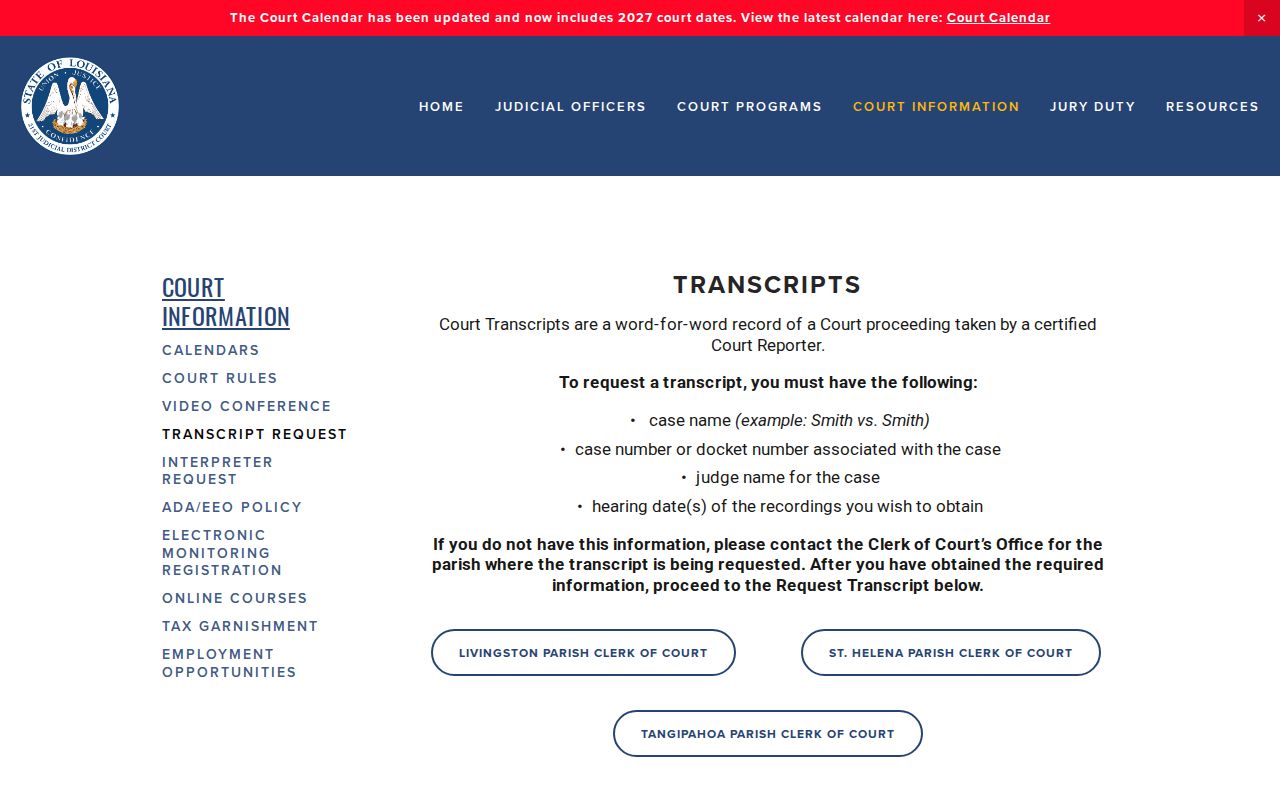
For a transcript, contact the court reporter. For minutes or a certified clerk copy, contact the records office the court names. Note: A minute extract can document a court event, but only the reporter creates a verbatim hearing transcript.
Certified Copies and Fees in Louisiana
A plain copy of a Louisiana court record carries no clerk certification. The certified copy is different. The clerk issues it as the official version, usually under seal. A minute extract may carry its own price. Louisiana sets no single statewide fee or process for an exemplified or triple-seal copy. Ask the clerk which authentication that office provides.
Before you pay anything, request the page count and the total. Search fees, certification charges, postage, and delivery costs can all apply. Civil copies and minute extracts may also be priced at different rates. Get the full figure up front.
| Local Example | Published Charge | Scope |
|---|---|---|
| St. Tammany civil/succession form | $1 per page; $5 per certified document; $10 for certified minutes, plus postage | Local form and service only; clerk quotes page count and total. |
| Tangipahoa copy schedule | Examples list $1 per page, $5 certification, and $5 for minutes | Local copy rates; filing charges are listed separately. |
| Rapides civil and minute copies | $1 per civil page plus $5 certification; $10 per minute extract plus $5 certification | Local examples; its one-name/one-index search is listed separately at $20 plus $10 per name variation. |
Any charge figures you see cited for Louisiana copy work are local examples. They are not statewide rates, and your invoice may differ. Confirm the clerk's current fee schedule, accepted payment methods, and any archive or postage cost before sending money.
Scope a Louisiana Court Record Request Before Paying
Help the clerk find the file fast. Give the parish, the court, the division, and the case number if you have it. Add the party name as printed, the filing date, and the exact document or minute date. Say how many plain or certified copies you want. Say how they should come back to you. Also ask whether the file sits in archives or whether a search charge applies.
One civil-copy form used by a St. Tammany office in 2025 shows the pattern. It asks for the suit or succession number, the parties, and the item and its date. Copy counts, certification counts, and return details follow. You can request a full file or just named documents. That process belongs to that office alone. Treat it as an example, not a statewide rule.
- Ask for an estimated page count and total.
- Separate a docket, minute, filing, judgment, and transcript request.
- Choose plain or certified copies and confirm payment and return methods.
The St. Tammany Civil Records Copy Request form shows what one local clerk's request workflow looks like. Its fields and prices fit that office only, so check the current form and contact the right clerk before you rely on it elsewhere.
Note: Requesting a whole file can cost more than asking for one named pleading or a single dated minute entry.
Public Access and Sealed Records in Louisiana
Louisiana law opens court records to inspection and copying. Other statutes and court rules still apply. Article 251 names the clerk as custodian of the record. That openness stops at certain doors. Juvenile, sealed, expunged, and protected material stays off the public internet.
Ask the clerk whether a redacted public version exists and how restricted items are handled. Remote access, in-person inspection, and certified copies are three separate things. R.S. 13:5992 covers defined criminal minutes. It leaves traffic out. It does not require every pleading or image to appear online.
Louisiana access rules:
La. C.C.P. art. 251 addresses clerk custody, inspection, copying, and certified true copies, subject to other law and court rules.
La. R.S. 44:31 states the public-record access right and assigns the custodian the burden to justify an exemption.
La. R.S. 13:5992 requires access to specified criminal minute entries for covered cases, while excluding traffic violations.
When a Louisiana Public-Records Request Needs Follow-Up
La. R.S. 44:32 governs reasonable charges and how a request should be made. Follow the clerk's instructions and spell out the case, the item, and the date. Court-specific rules can add their own requirements for court-file requests.
Timing matters under La. R.S. 44:35. If five business days pass without a written determination or an estimated response time, an enforcement route can open. That is not a promise your request will be finished inside five days, though. Read the current law and court rules before you act on a delay or denial.
The clerk can also explain archive or image limits. Use the parish directory to reach the right office.
Note: Keep the dates of your request and any response, but review court-specific rules before you push back on a delay or denial.