
How to Search Louisiana Criminal Dockets
Pull out the case papers first. The court, parish, division, case number, party name, and rough filing year are printed there. Those details will narrow almost any docket search. Louisiana does offer a statewide tool. It is the LCRAA Criminal Search through eClerks LA, though an account is required and it covers a defined set of criminal minute entries. It is not a substitute for every parish or local court lookup. Local systems vary in what they index or scan. A missing result can mean the case sits in another court, is older, or simply falls outside the online module.
Work the case in steps. Then confirm details with the clerk or court named in the record. No single case-number pattern spans every district and lower court. Never guess a format borrowed from another parish. When you need a full criminal docket or a filed instrument, route from the parish to its Clerk of Court and the right criminal division. Orleans Parish adds a wrinkle. Felony matters there run through a separate Criminal District Court Clerk.
- Identify the court and parish from the summons, bill, or other case paper. Confirm whether the case is district, city, parish, mayor's, juvenile, or another local matter.
- Try the LCRAA Criminal Search for an eligible case, knowing that the public entry page leads to account sign-in and does not reveal the post-login search fields.
- If the statewide result is absent or too brief, use the parish clerk's official search or contact the clerk's criminal records office. The Louisiana parish directory routes to the local clerk; city and other limited courts may have separate clerks.
- Read each event as an entry, then request the actual motion, order, or judgment if its terms matter. A minute entry is not a transcript or a copy of the filed document.
- Ask the custodian about plain or certified copies, current fees, and accepted submission and return methods before sending payment.
Louisiana Criminal Minutes in LCRAA
Before anything can be searched, the LCRAA criminal-search page stops at a login wall. What the visitor meets is an email and password sign-in. An account registration link sits with it. The query form stays hidden until you authenticate. Parish or court choices, case fields, date filters, result limits, export options, fees, and refresh timing remain unknown from the outside. No Louisiana search should be promised those features.
The LCRAA Criminal Search can help locate statutory minute entries. A result there is still only a summary layer. If the case does not appear, contact the local clerk directly. That also goes for an indictment, motion, exhibit, signed order, or transcript. The statewide interface cannot promise that any particular filing or image is online.
The official LCRAA Criminal Search entry page lays out the account boundary ahead of the query controls.
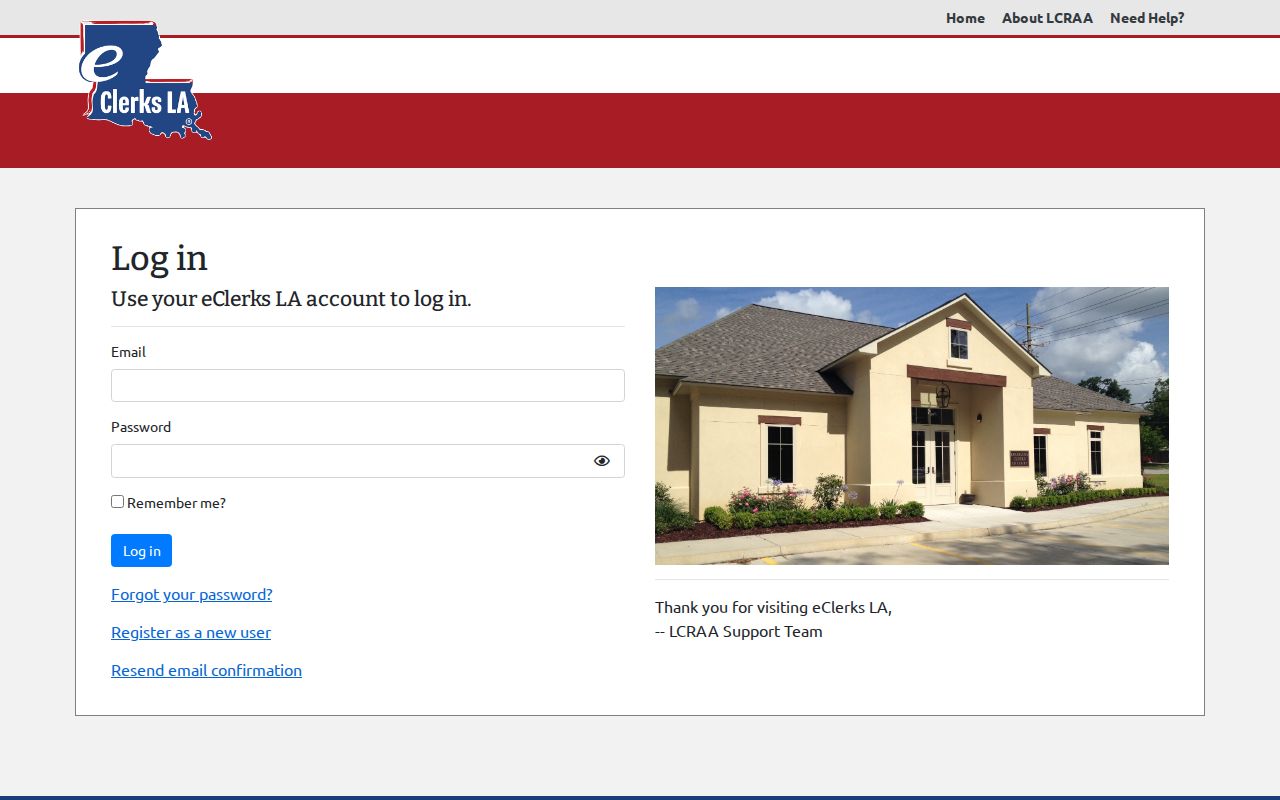
The official screen shows the sign-in step alone. A portal login page cannot confirm which parishes or case fields become searchable after authentication.
What a Criminal Docket Shows
Think of a Louisiana criminal docket as a timeline. Wording and screen layout change with each clerk's system, but the entries tend to cover familiar ground: a charge or amendment, arraignment, custody or bail details, motions, hearings, trial or adjudication, sentencing, and the closing event. Some entries are just a short label. The docket does not necessarily reproduce the charging paper, hearing transcript, evidence, or full order behind that line.
There is no single official statewide case-number format or docket-code glossary in Louisiana. Local captions and docket legends carry real weight. Read each date as a recorded event or setting, nothing more. A brief line leaves the legal effect unclear. Check the signed order or ask the clerk.
| Case Number | The court-assigned identifier. Format varies by clerk, court type, and year; no one Louisiana format was verified. |
|---|---|
| Charge or Filing | A docket line can note a charge, amendment, or motion. The charging instrument and later filings are separate records. |
| Minute Entry | A concise record of court action, not a verbatim transcript and not necessarily the signed order. |
| Hearing Setting | A scheduled proceeding such as arraignment, motion, status, or trial. The date can change and may appear only in local records. |
| Plea or Finding | The docket may summarize the plea or adjudication; the underlying record may contain more detail. |
| Disposition | An outcome or closing event. Check whether it concerns a count or the whole case, and read the judgment where needed. |
R.S. 13:5992 sets a floor for covered criminal minute entries, not a uniform screen or complete case file. Local portals may label the same event differently. A case-index hit is not a certified record either.
Louisiana Criminal Minute Entry Coverage
Dates drive the statewide rule. Louisiana's criminal-minute access mandate applies only to criminal cases filed on or after January 1, 2020. It requires public electronic access through LCRAA to the covered minute entries or summaries. Older cases may still surface in local clerk systems or archives. That access exists on its own, not because the statewide mandate created it.
Traffic violations are excluded. So is nearly everything juvenile. There is one narrow exception. Minute entries in juvenile cases alleging a violent crime filed on or after January 1, 2024 stay open unless sealed or expunged. That exception does not open juvenile records generally. In scope, the minute-entry law creates a summary lane. It is not a promise of every indictment, motion, exhibit, warrant, or scanned page in the case file.
Coverage point: An absent result does not prove that a criminal case is sealed. Check filing year, case type, court, and parish, then ask the clerk about the proper local access route.
Note: Whether the LCRAA mandate applies to a Louisiana criminal matter turns on the filing date and the record category.
Stages on a Criminal Docket
A criminal case leaves a trail of docket marks as it moves through Louisiana courts. The filing opens the record. Later entries may note custody or bail. Arraignment, motion practice, status hearings, trial or adjudication, a finding, and sentencing may appear after that. Read the docket as a timeline of what was entered, not as full context for each hearing.
Docket flow: Charge Filed › Arraignment › Pretrial or Motion Settings › Plea or Trial › Finding and Disposition › Sentencing, when applicable
One change rarely ends everything. Louisiana records can show an amendment, dismissal, or nolle prosequi on a single count while another count stays active. Check the case-level outcome and any signed judgment before treating one event as the close of the whole matter.
Missing Louisiana Criminal Case Results
A missing result has many possible causes. Start with the case paper. Match it to the parish and court you actually searched. Some Louisiana matters sit in a city or parish court. That court has its own portal. Others predate the 2020 statutory date boundary. Juvenile, sealed, and expunged records carry their own access limits. A blank statewide result cannot tell you which explanation fits, so take the paper to the parish Clerk of Court's criminal division or the court named on it. Ask for a specific filing or order by document and date, not just "the case." An entry should be public under the minute rule. It never appears. Question the clerk about LCRAA access and the local record. Clerks can confirm current status and explain the copy or request process.
Note: A missing next hearing date may simply mean the matter is continued without date or awaits a local division calendar.
Which Court Holds Criminal Dockets
Felony cases in Louisiana generally travel through Louisiana District Courts. Misdemeanors and ordinance violations often land in city, parish, mayor's, or other local courts instead. Check the citation or charging paper to see which court holds the docket. The structure matters here: 43 court units spread across 42 numbered judicial districts. That makes a district label and the parish clerk's division as important as any search term. Treat both as key parts of a statewide search.
| Court Level | Common Criminal Record | Search Route |
|---|---|---|
| District court | Felony filings, minutes, hearings, disposition, and sentence | Parish Clerk of Court criminal division; Orleans uses its separate Criminal District Court clerk |
| City, parish, or mayor's court | Many lower-level misdemeanors and ordinance matters | Use the court named on the citation or charging paper |
| Juvenile court or assigned clerk | Juvenile delinquency records under special access rules | Ask the named court or assigned custodian about lawful access |
Those 42 numbered districts do not line up one-to-one with parish count. Limited-jurisdiction courts may keep their own records entirely. Use the parish directory to reach a local Clerk of Court first. Then follow the court name printed on the paper if the case belongs to a city, mayor's, parish, or justice-of-the-peace court.
Reading Louisiana Criminal Docket Entries
Docket entries in Louisiana describe different records and events. A minute entry is the clerk's concise summary. A transcript is the reporter's verbatim account. A motion asks the court for action; an order records the court's direction. Local systems abbreviate events in their own ways, and the state publishes no official code list.
- Arraignment
- A criminal appearance where charge and plea steps occur; the docket may record the event without the full exchange.
- Bond or bail
- A pretrial release or security entry. The available detail may be limited.
- Continued without date
- A matter leaves a fixed setting and awaits a later date; check the court's next notice.
- Nolle prosequi
- A prosecutor's formal abandonment of a charge. Confirm whether it applies to one count or the full case.
- Disposition
- An outcome or closing entry. Review the judgment to understand its scope.
Use the local legend whenever one exists. A case status label is not the signed judgment. A short event line rarely explains the court's full ruling.
Public Access and Sealed Criminal Dockets
Louisiana's Public Records Law grants a general right to inspect public records. It does not promise that every court filing is viewable from home. Louisiana Code of Civil Procedure article 251 makes the clerk custodian of court records and allows inspection and copying during office hours, unless another rule applies. A court can still restrict a case or document by statute or order, and electronic filings require care with personal identifiers.
Juvenile records carry confidentiality protections under the Children's Code. Expungement and sealing change public access without erasing the official court record. A blank search, limited fields, or an access-denied screen does not settle whether a record is sealed. Ask the clerk what procedure applies, without seeking protected case details.
Louisiana access rules:
La. R.S. 13:5992 requires access to covered criminal minute entries from the statutory filing period, while excluding traffic violations and underlying pleadings or images.
La. C.C.P. art. 251 addresses clerk custody, inspection, copying, and certified copies, subject to other access rules.
La. Children's Code art. 412 governs confidentiality of juvenile records, with only narrow statutory exceptions.
Note: Public access to a Louisiana minute summary does not mean every document attached to the criminal case is open online. Some filings stay offline by rule or by order.
Louisiana Criminal Docket Requests
When online access falls short, send the request to the official custodian. Begin with the parish Clerk of Court directory kept by the Louisiana Secretary of State, then confirm the criminal division and court. Name the case number if known, plus the party or case style, the filing year, and the exact minute, motion, order, or judgment you need. One caution: do not assume the same office handles every local court.
- Inspect or copy the record in person during clerk office hours where access rules allow.
- Ask whether the clerk accepts a written or electronic request, and whether mail, phone, or pickup can be used for the specific record.
- Ask whether a public terminal is available locally; Louisiana does not provide one uniform statewide terminal service.
- For public-record requests, follow the custodian's accepted process under La. R.S. 44:31 and ask about reasonable copy charges under R.S. 44:32.
Louisiana sets no statewide criminal-copy fee or turnaround schedule. A clerk may quote a page total, require advance payment, or send a transcript request to the court reporter. Certified minutes and plain copies are different products, so say which one you want. Orleans felony records go through the separate Criminal District Court clerk, not the civil clerk. The Orleans civil clerk's official description documents those separate civil and criminal routes.