
Louisiana Court Calendars
Trial dates in Louisiana are set and posted locally, by courts, divisions, clerks, or coordinators. One calendar might show a day of hearings. It could be a judge's weekly docket or a jury-trial block. Fields vary with the local system. A court calendar is not the same record as a case docket. The docket tracks filings and case events as they happen, including settings once entered. Calendars can leave out parties or case numbers. They may cover only some divisions, and they shift whenever the court acts.
No statewide public trial-calendar search exists for Louisiana. Tools like eClerks LA and LCRAA can surface case indexes and minute entries. Yet neither stitches together local hearing schedules. Go to the court named on your notice, citation, or case paper. The parish directory leads to the local clerk or court website. From there, confirm any uncertain setting with the division or coordinator.
Louisiana Has No Statewide Trial Calendar
A statewide case index is not a statewide trial schedule. Louisiana court calendars stay local because each court runs its own divisions and settings. The Louisiana Supreme Court's Office of the Judicial Administrator handles statewide administration and reporting. But it is not a trial-court clerk, and it posts no schedule replacing parish and court calendars.
The 21st Judicial District Court calendar page shows how one court handles this. It links a Court Calendar plus a separate Duty Judge Calendar, hosted through Teamup. The district covers Livingston, St. Helena, and Tangipahoa Parishes. Its page proves a single court can publish more than one schedule. It is not a Louisiana-wide calendar.
The official 21st JDC calendar page offers those local schedule routes and claims no statewide coverage.
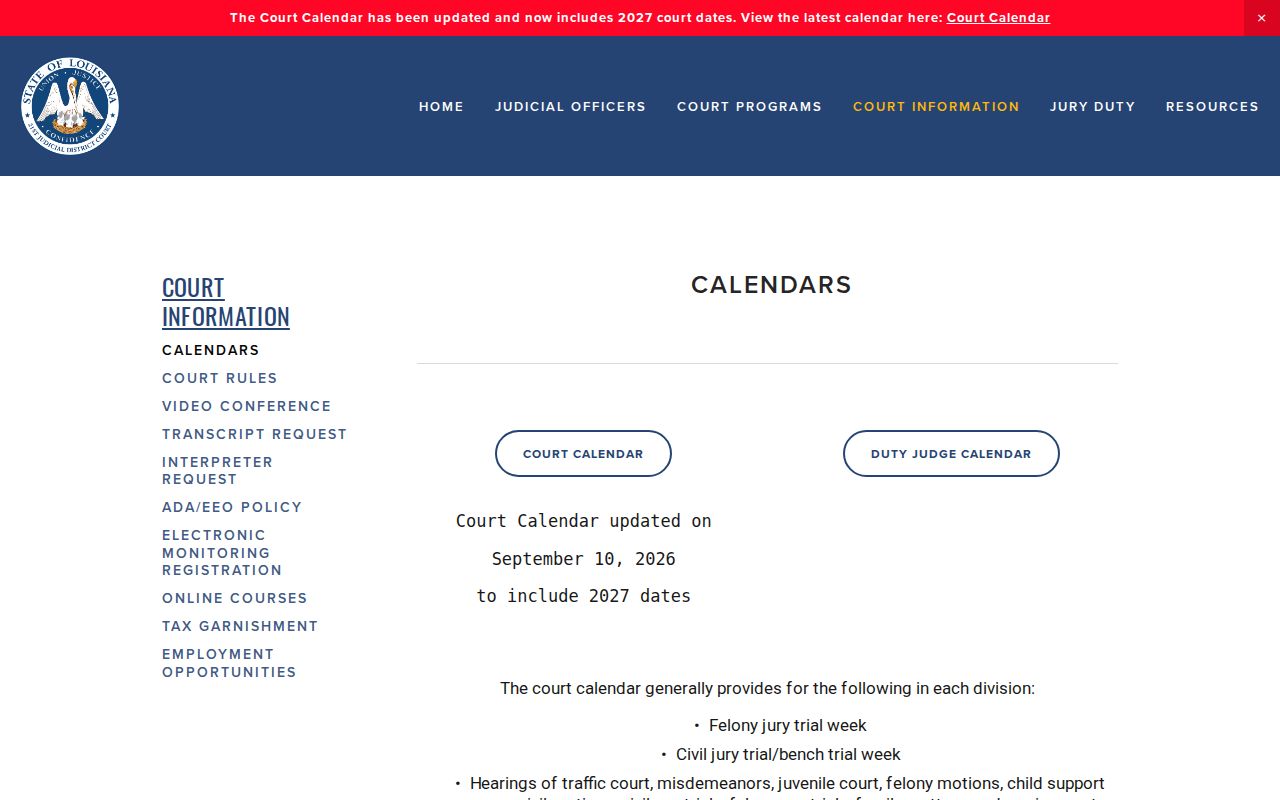
This local example helps you spot calendar types, but the court named in the case is still where the relevant setting lives.
Note: A Louisiana court website may link to a calendar service that sits apart from its case-search portal.
How to Find a Court Date
Start with the court, case number, and division. These appear on the summons, citation, or latest order. Louisiana has no single search screen returning every trial-court setting. A statewide index may locate a covered civil, family, succession, or criminal-minute record. Yet the date itself must be checked with the local court system. The parish Clerk of Court is the usual stop for district cases. City, mayor's, parish, and justice-of-the-peace courts often keep their own calendars and case records.
- Check a statewide index only if its record category applies. eClerks LA is an index gateway; LCRAA criminal minutes have a filing-date boundary and exclude traffic.
- Copy the court name, division, and case number exactly. Louisiana case formats and local search labels differ.
- Open the court's local docket or calendar. The Louisiana parish directory can route to the parish Clerk of Court; follow the citation directly for a city or other separate court.
- Check any posted daily list or courthouse calendar if the court provides one. Some schedules are limited to a division or docket block.
- If the setting is unclear or recently changed, call the clerk, court coordinator, or division office. In-person inspection may also be available under the court's local process.
If a local calendar and the case docket disagree, do not assume the setting was canceled. Confirm the date, time, courtroom or division, and appearance method with the court, and follow the served notice or order.
Louisiana Trial Calendar vs Case Docket
A calendar is an operational schedule. A case docket is the event history for one file. In Louisiana, neither substitutes for the court's notice or order. The calendar may group cases by division or time block, while the docket records a setting, or a later reset, once that entry is made.
| Source | May Show | Use It For |
|---|---|---|
| Local court calendar | Schedule block, judge or division, and possibly a time or room | Finding a published court schedule; fields vary by court |
| Case docket or minutes | Case-specific setting, reset, hearing result, or minute entry | Following the event history; entries may not include the full order |
| Served notice or signed order | Directions for the case and the date stated by the court | Confirming what a party must follow when web pages differ |
The 21st JDC calendar page is one local example, not a universal Louisiana field list. Its public calendar service does not display event-level fields, so no Louisiana calendar can be assumed to show a case number, party, room, or judge.
Note: The public 21st JDC calendar does not establish which fields every Louisiana court publishes.
Reading a Court Setting
A Louisiana setting may carry a date, time, court or division, judge, courtroom, and hearing type, though the public view often omits pieces of that. Treat the field list here as a practical checklist rather than a guaranteed statewide layout. A weekly jury block or duty schedule can be broader than one case's appearance entry.
| Case Number | Identifier for the case, if the local calendar lists one. Verify it against the case docket. |
|---|---|
| Setting Date & Time | Scheduled date and time, if shown; check the court notice for the controlling detail. |
| Court & Division | The court, judge, courtroom, or division may be listed separately or omitted from a block calendar. |
| Hearing Type | May describe a motion, status, pretrial, arraignment, trial, or another local calendar category. |
| Setting Status | A set, reset, continued, or canceled notation depends on the court's local terms. |
Use these fields to compare a calendar line against the case papers. Louisiana courts share no statewide event-label standard, so confirm a vague setting with the issuing court.
Louisiana Setting Terms on a Docket
Calendar labels usually name the type of court work, not the result of any case. A Louisiana docket can record a setting after a filing, and a later minute entry shows whether the matter was heard, moved, or set for another date. Local abbreviations are not a uniform statewide code.
- Set
- Placed on a court calendar for a hearing or other proceeding.
- Continued
- Moved to a later date or postponed; check whether a new date is shown.
- Continued without date
- Taken off the fixed date while awaiting a later setting.
- Docket call
- A court call of cases for readiness, scheduling, or disposition, with local practice controlling.
- Duty judge calendar
- A schedule for a designated judge or duty function, distinct from an ordinary division calendar in the local example.
Note: A Louisiana setting term does not prove a hearing happened or that the case ended; check the matching minute entry or order.
Resets, Continuances, and Cancellations
Three words describe schedule changes on a Louisiana docket. A reset hands the case a new setting. A continuance pushes a proceeding to a later date. A cancellation drops the event or swaps it for something else. Courts here may record the change on the docket, on a local calendar, in a notice, or across all of them. The label and timing differ from court to court. One caution matters most: if the online entry is missing, the date still stands.
The 21st Judicial District Court showed how varied one closure can be. A January 2025 weather order from that court shut operations for three days. Civil, domestic, juvenile, child-support, and protective matters were reset with notice. Criminal, misdemeanor, and traffic defendants had to contact the court by January 30 for new dates. Specialty matters were simply canceled. The order's category-specific instructions bind only that court and that event, not the whole state.
Whenever a closure or change hits your case, read the current order. If the docket and calendar leave questions open, call the division the order names.
When a Louisiana Date and Notice Differ
Say the online Louisiana court calendar shows one date and your served notice shows another. Don't guess which wins yet. First compare the court, the division, the case number, and the date on each document. Calendars update on their own schedule. So an entry may lag behind a filed continuance or reset. The 21st JDC weather order proves the point. One closure notice can point different docket categories toward completely different next steps.
Work the mismatch in this order:
- Read the newest court-issued notice or order and check whether it names the case or a category that includes it.
- Call the clerk, coordinator, or division listed on the case paper and ask whether the setting has changed.
- Keep the notice and the confirmation details, and follow the court's instructions about appearance or a new date.
Note: A Louisiana calendar listing that's missing is not a cancellation. Confirm the actual case date with the court.
What To Do If You Miss a Setting
Missed a Louisiana court date? Contact the court or division right away. What happens next turns on the case type and the order entered. The docket may show a new setting, a failure-to-appear event, or some other action. A missed criminal appearance can trigger additional court process. A civil matter, though, may keep moving toward a ruling or a default. A calendar alone tells you none of that, so assume no result from it.
If the setting was missed: Call the court named in the notice or citation and ask what was entered and what action is required. Confirm any new date directly with the division. If the docket refers to a warrant, default, or other order, request the official entry from the clerk and follow the court's instructions.
In a Louisiana criminal case, the clerk keeps the minutes. The verbatim transcript is a separate product, prepared by the reporter. For a civil default or an FTA status, check the signed order or the official case record rather than a calendar line.
Louisiana Remote and Appellate Calendars
Every Louisiana court and division writes its own rules for appearing remotely. The 21st JDC video-conference information lays out rooms by division and its waiting-room practice. None of that sets a statewide remote-hearing rule, though. Read the case notice before you join online or drive to the courthouse. Check that court's current policy too.
Appellate argument calendars live apart from trial-court settings. The Louisiana Courts of Appeal each publish circuit-specific material. The Second Circuit calendar sits on its own court site. One case can carry both a trial setting and an appeal date. Yet the two sit in different docket systems. Federal hearing calendars are separate again, and they never confirm a Louisiana state-court date.
Send an appellate question to the correct circuit court. Send a trial-setting question to the court that issued the notice. Even on appeal, Louisiana's split still governs where you look. Local calendars sit in one place. Case dockets sit in another.
Note: A remote link, a duty schedule, a trial calendar, and an appellate argument calendar are different tools. Each is scoped to its own court.