
How to Search Court Dockets in Louisiana
A good Louisiana docket search starts with the court named on your summons, citation, or filing. Louisiana runs local court and clerk systems. So any index result is only a first step. The Parish Clerk of Court, or the clerk serving that court, keeps the official case record. Try the statewide gateway when your case fits its listed categories. Then move to the local source. That source has the full docket, the current status, or a filed paper.
- Identify the parish, court and division from the case paper. A city or justice-of-the-peace court may keep its own traffic or limited-jurisdiction file.
- Search eClerks LA for its civil, family, succession or other listed index categories. For a covered criminal case filed from January 1, 2020 onward, try the separate LCRAA Criminal Search.
- If the result is absent or brief, use the official parish Clerk of Court or named local court search. The local clerk can confirm the case number and event history.
- Read the docket line as an event summary. Find the actual order, motion or judgment when its full wording matters.
- Ask the record custodian for a plain copy, certified copy or transcript by name. These products come from different offices and may have separate charges.
When the filing court is local, the Louisiana parish directory is your next stop. For the bigger picture, the Louisiana court system page lays out the statewide structure.
Why Louisiana's 64 Parishes Search Differently
Louisiana has a statewide case-access gateway. It is not one trial-court database holding every docket and document, though. Each local court builds and keeps its case record in its own case-management system. The custodian varies: a parish clerk, a city-court clerk, or a justice-of-the-peace office, depending on the court and case type. Some clerks offer a direct online index. Others go through a vendor or handle older records at the counter.
When the portal references all 64 parishes, it names index categories. It does not name every local court, every year, or every document image. A blank result does not prove no case exists. The case could sit in a limited-jurisdiction court, sit with a separate local provider, or be confidential. It could fall outside the digitized years. It could simply not be included yet. The parish roster makes a useful starting map. But the court printed on the filing controls where the official docket lives.
The Louisiana DOTD parish layer lists the state's parish units. Court-unit and judge totals come from the Louisiana Supreme Court's 2025 Annual Report.
Note: eClerks LA results cover listed parish services and case classes. So a blank result does not establish that no Louisiana case exists.
The Louisiana Statewide Case Search
eClerks LA, also called the Louisiana Statewide Portal, is run through the Louisiana Clerks' Remote Access Authority (LCRAA). Its public description advertises index searching across participating parish services. Those categories include land, marriage, civil and family, and succession or probate materials. Some links open a parish product. Images or printed records may require a purchase or subscription. Local coverage differs parish to parish.
Treat the portal as less than a complete statewide trial docket. It promises no live calendar, every filing, all historical years, every lower court, or a full document scan. Parish clerks remain the source custodians. The separate criminal search sits behind an account gate. It applies a narrower statutory minimum for minute entries. The Louisiana court system discussion maps the details, including what the portal does not establish.
A no-match page can reflect the court, record class, date range, privacy rule, or local update path. It may not reflect the absence of a case. Check the named court's official site and ask the clerk before treating a blank result as final.
Search Fields on the Louisiana Portal
The public eClerks entry path shows sign-in and account-registration controls before any statewide query. The parish and case search fields sit behind that login. No statewide dropdown list, required query fields, result cap, export option, or refresh schedule is published, so do not count on any of those details.
| Visible stage | Control or category | What it establishes |
|---|---|---|
| Sign-in | Email, password, remember-me checkbox | These are login controls, not case-search fields. |
| Account registration | Email, phone, password and contact fields | Account setup; field requirements vary in the rendered form. |
| Listed index classes | Land, marriage, civil/family and succession/probate | Published categories, not a guarantee of every file or year. |
| After sign-in | Parish and case query fields not publicly verified | Confirm the current query options in the official portal. |
For current sign-in steps, use the official eClerks LA entry page. An account does not turn the gateway into a certified court copy or a complete trial file.
Louisiana portal overview image: view the official statewide portal description.
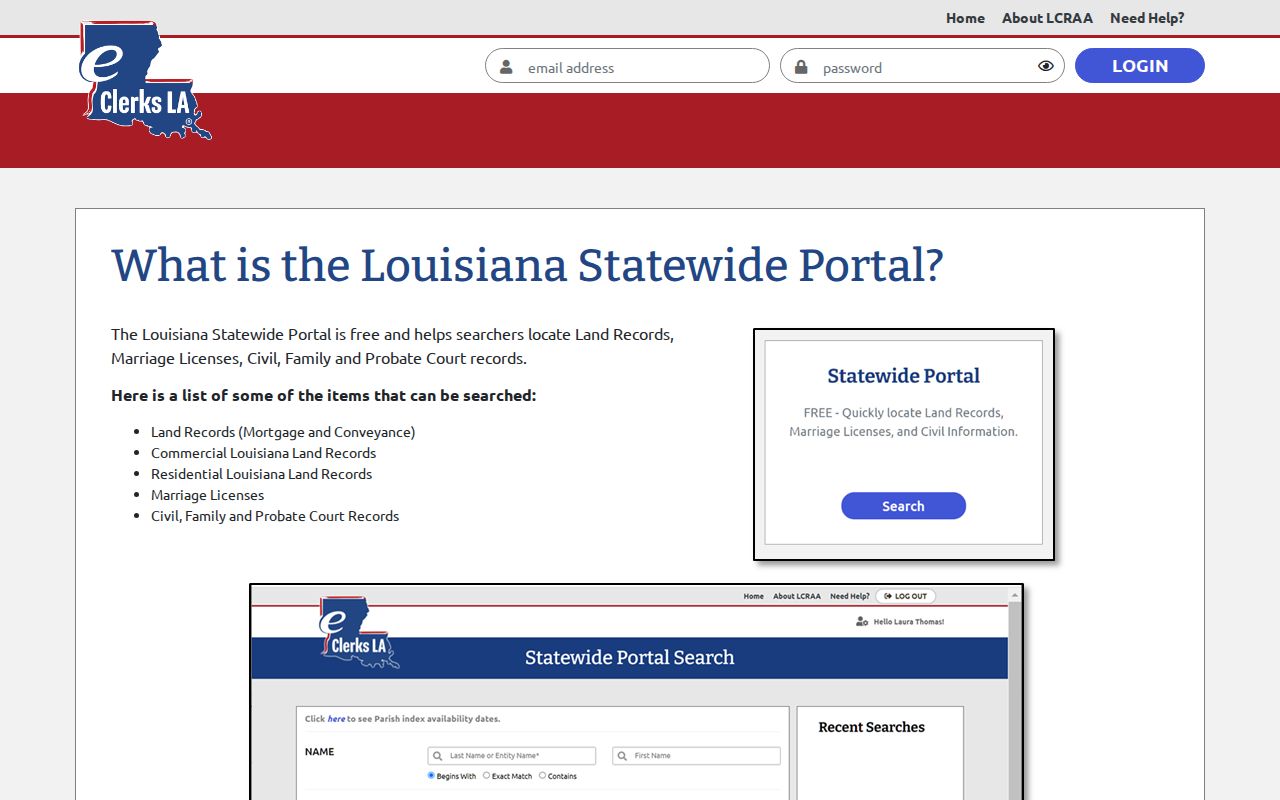
The published scope statement appears in that overview. For parish-specific record access and image terms, check the relevant local service directly.
Which Courts Keep Dockets
Louisiana court dockets live at the court level where the case was filed. District courts form the general trial tier. They handle major civil cases and felony matters. Local courts hear whatever their jurisdiction assigns. The 2025 Louisiana Supreme Court Annual Report counts 43 district-court units spread across 42 numbered judicial districts. Orleans keeps distinct Civil and Criminal District Courts. An appeal creates a separate appellate record.
| Court | Docket Covers | Where to Search |
|---|---|---|
| Louisiana District Courts | Major civil matters, felony criminal cases, and locally assigned family, juvenile and succession work | Parish Clerk of Court or assigned clerk |
| Juvenile and family courts | Specialized cases with additional confidentiality limits | Specialized court or assigned clerk |
| City, parish, mayor's and justice-of-the-peace courts | Local traffic, ordinance and limited civil or criminal matters | The court named on the citation or filing |
| Louisiana Courts of Appeal | Appeals and writ applications in five circuits | The relevant circuit's own clerk and case search |
| Louisiana Supreme Court | State's highest appellate matters and other assigned work | Supreme Court public case information; CDX is attorney e-filing |
Go by the court named on the case paper. Do not assume a district clerk holds every Louisiana case. A federal filing belongs in PACER, not the state index.
Note: Judicial district boundaries can cross parish lines. Orleans has two distinct district-court units and clerk offices.
How Louisiana Dockets Reach the Index
Louisiana's docket flow has distinct custodians and access layers. The local clerk creates and maintains the official register and minutes. A parish case-management system may then expose an index, a scanned document, or a remote-access service. LCRAA can make selected records searchable through eClerks LA or another linked product. Appellate courts keep their own records. The Office of the Judicial Administrator collects court statistics, not public case-level docket entries.
Louisiana filing → local court docket → eligible parish index or portal → separate appellate docket, if appealed. This path explains why a statewide search can locate a case without displaying every event or paper. It also explains why a docket entry from one court does not replace the file maintained by another clerk.
Louisiana's 2025 Filing Totals
The 2025 Louisiana Supreme Court Annual Report gives two different totals for district-court filings. Its narrative says 578,107. The case-type table breaks that work down into 17,293 juvenile, 147,258 civil, 135,252 criminal and 270,930 traffic filings. Those add to 570,733. The report never explains the gap. Treat neither number as a settled statewide count of Louisiana court filings.
The year-over-year picture is clearer. Civil filings rose 5 percent. Traffic rose 9 percent, while criminal filings fell 2 percent and juvenile filings fell 5 percent. The report also tallies 112 civil and 574 criminal jury trials. Those trials are outcomes, not filings. They say nothing about a single case's wait time or how it will end.
What a Louisiana Court Docket Shows
A Louisiana docket or case-history screen is a timeline, not a transcript. It lists what happened in a case in order. It does not reproduce every hearing word for word. It is not a copy of each filing. Local case systems format these entries their own way. Louisiana has no single statewide case-number pattern or official code list. The case number, party caption and event label will help you locate the court file. Just remember the docket text can be shorter than the order or pleading behind it.
| Case number | Court-assigned identifier; format varies by clerk, court type and year. |
|---|---|
| Parties | Names or a shortened caption; protected matters may use limited public labels. |
| Docket entries | Filing and event summaries; the underlying document may be separate. |
| Hearing settings | A scheduled proceeding; confirm date and time with the court. |
| Court and judge | The filing court and presiding judicial officer where shown. |
| Disposition | An outcome or closing event; the signed judgment supplies its full terms. |
A filing date is not a hearing date. A line noting that an order was signed only points to a separate order. The docket summary alone may not spell out every condition or count it affects.
Docket, Minute Entry and Filed Order
Louisiana court materials use "docket," "minutes," "minute entry," "case history" and "case information" differently from parish to parish. The word docket usually means the running register of a case. A minute entry is a short account of an action taken in court. Neither one is automatically a verbatim transcript or the full text of the filed paper.
- Docket or case history
- A chronological list of filings and court events.
- Minute entry
- A clerk's summary of an event; it is not a word-for-word transcript.
- Filed document
- The actual petition, motion, order or judgment in the case file.
- Transcript
- A verbatim record prepared by an official court reporter.
- Reset
- A new setting after a date changes; verify the notice and new date.
Local abbreviations are not a statewide codebook. When a Louisiana docket uses a term you cannot read, ask the filing court or clerk for its legend and request the associated document. Note: Louisiana has no single statewide case-number format; use the identifier exactly as assigned by the local court.
Louisiana Criminal Minutes Since 2020
Louisiana Revised Statutes 13:5992 requires electronic public access through LCRAA to specified criminal minute entries or summaries for district-court criminal cases filed on or after January 1, 2020. The covered information can include charge changes, custody or bail, motions, hearings, trial or adjudication, sentence by count, the hearing date and key court roles. The law does not put every pleading, exhibit or scanned image online.
Traffic violations are excluded outright. Older criminal files may still sit with the local clerk, but the statute's date rule does not promise they are indexed in the statewide service. One narrow exception allows public minutes for certain juvenile violent-crime accusations filed from January 1, 2024, unless sealed or expunged. That exception does not open juvenile records generally.
When a criminal entry is missing or too brief, ask the clerk serving the court about the local docket, a copy of the minute entry or a particular filed document. The statewide rule creates a defined access lane, not a complete online criminal file.
Public Access to Dockets
Louisiana's Public Records Law, La. R.S. 44:1 et seq., sets general public-record request rules. Separate court-file inspection and confidentiality rules also apply. Under La. C.C.P. art. 251, the clerk is custodian of court records. Inspection or copying is generally available during office hours unless another law or court rule limits access. Remote search, document images and certified copies are separate products.
Louisiana access rules:
La. R.S. 44:31 states the right to inspect, copy or reproduce public records, subject to lawful exceptions.
La. R.S. 44:32 allows reasonable copy charges and uniform procedures.
La. R.S. 44:35 provides court remedies when a public-record request is denied or not handled as law requires.
La. R.S. 13:5992 sets the narrow statewide criminal-minute access rule and excludes traffic violations.
La. Children's Code art. 412 protects juvenile records, subject to specific statutory exceptions.
A search result may omit sealed, juvenile, expunged or protected material. An empty screen tells you nothing about why a record is absent. Public case access does not authorize reuse of personal identifiers.
Louisiana Docket Index vs Certified Copy
A free index, a paid image, a certified copy and a transcript are different products. The statewide portal may show a case name or event line. But the clerk holds the record you need for an official copy. Louisiana clerks set copy and certification practices locally. Public fee pages in St. Tammany, Rapides and Tangipahoa show charges that vary by page, record type and certification. No single statewide copy-fee schedule exists.
Before you send payment, identify the exact paper or minutes. Ask whether the clerk can quote a page count. Say whether you want a plain or certified copy. A transcript must come from the official court reporter. A docket line marked "judgment" does not hand you the signed judgment. La. R.S. 44:32 permits reasonable reproduction charges; it does not set one uniform parish invoice. Confirm current prices and accepted payment methods with the office that keeps the case.
Louisiana's 2026 E-Filing Rules
Louisiana never built a single e-filing portal for all its trial courts. Instead, eClerks LA serves as a hub. It links to parish filing and recording services, and the local providers vary from place to place. Attorney filings before the Louisiana Supreme Court run through a separate CDX system. Each product has its own users, its own rules, and its own purpose. One caution: holding an e-filing account does not give anyone a public docket search.
Act 694 of 2024 rewrote the state's electronic filing and court-record rules. The changes take effect January 1, 2026. Clerks must now facilitate electronic filing, recording, and remote access through approved systems. The law does not force every filing to be electronic. Paper filing still works where law and court rule allow it.
The public access timeline moved in stages. LCRAA was created in 2014. eClerks LA launched in 2015. The criminal-minute access statute set a 2020 filing threshold. Act 694 then updated the filing framework for 2026. Each step added an access path. Local case systems and records custodians stayed in place throughout.
Where Louisiana Court Dates Appear
A Louisiana court date can surface in several places. The case docket, a local calendar, a written order, a posted courthouse list, or an appellate schedule are all candidates. There is no verified statewide public trial calendar. A public calendar may name a judge, courtroom, or time block without listing every case. It can also be updated on a schedule of its own. The 21st Judicial District offers a local example. Its separate Court Calendar and Duty Judge Calendar serve only that district.
Always check the calendar against the notice or order in the case. If the dates clash, call the court clerk or division coordinator. Then follow the court-issued instruction. A missing calendar entry does not cancel a setting by itself. A closure order may also give different directions to civil, criminal, traffic, and specialty matters. Treat public calendars as operational schedules. The court-issued notice or order governs what the case actually requires.
Find Court Dockets by County in Louisiana
Louisiana's local units are parishes. Each parish route here leads to the court and clerk most likely to hold a district-court file. Parish names alone will not identify the clerk for every city, traffic, or justice-of-the-peace case. Check the court printed on the case paper. The featured parish links illustrate different court arrangements and service areas. They are not a population ranking.
East Baton Rouge Parish
Baton Rouge · 19th JDC; report lists 38,925 district filings for 2025.
Jefferson Parish
Gretna · 24th JDC; a separate route from Orleans Parish.
Orleans Parish
New Orleans · separate Civil and Criminal District Courts and clerks.
St. Tammany Parish
Covington · 22nd JDC; report lists 32,141 district filings for 2025.
Lafayette Parish
Lafayette · part of the 15th JDC with Acadia and Vermilion.
Caddo Parish
Shreveport · First JDC court hub in north Louisiana.
Calcasieu Parish
Lake Charles · 14th JDC; district records stay with local clerks.
Open the full directory of all 64 Louisiana parishes to reach any parish's local court docket route. Need to identify the official office? The parish Clerk of Court directory from the Louisiana Secretary of State can help.